

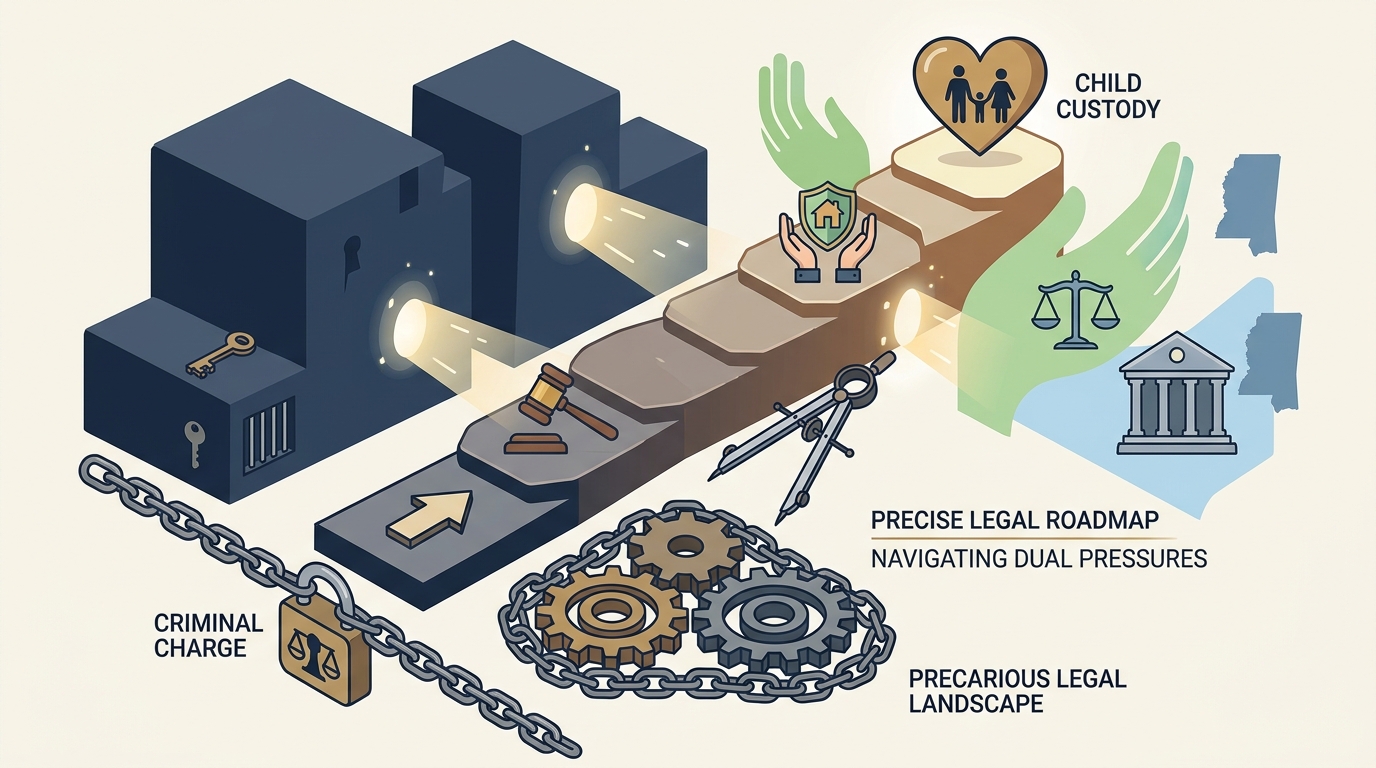
When a parent faces criminal charges in Mississippi, the intersection of criminal law and family law creates a precarious legal landscape. According to recent legal analyses, a criminal conviction can significantly alter custody arrangements, often leading to immediate temporary restrictions on parental rights. This guide provides a clear, step-by-step roadmap for protecting your parental rights while navigating the dual pressures of criminal defense and family court proceedings. Understanding the specific statutes and procedural requirements in Mississippi is essential for minimizing the negative impact on your custody case.
Step 1: Immediate Legal Coordination
The first and most critical step is ensuring that your criminal defense attorney and family law attorney are communicating effectively. In Mississippi, these two areas of law are distinct but deeply interconnected. A criminal charge alone does not automatically strip a parent of custody, but it triggers a heightened scrutiny from family court judges. Legal coordination is the foundation of a successful defense strategy.
Many individuals make the mistake of handling these cases in isolation. If your criminal case attorney is unaware of the custody implications, they may inadvertently make statements that harm your family law standing. Conversely, a family law attorney may not understand the nuances of criminal procedure that could delay or dismiss charges. At Housley Law, we emphasize a holistic approach to legal representation. We recommend scheduling a consultation to discuss how your criminal defense strategy can support your custody goals. Visit our contact page to schedule a free consultation with our experienced team.
Step 2: Understanding the "Best Interest" Standard
Mississippi family courts operate under the "best interest of the child" standard. This is the overarching principle that guides all custody decisions. Child custody is defined as the legal and physical rights and responsibilities a parent has regarding the care and upbringing of their child. The court evaluates various factors to determine what arrangement serves the child's welfare best. These factors include the parent's moral character, mental health, and ability to provide a stable environment.
A criminal charge raises questions about moral character and stability. However, the court distinguishes between the charge itself and the underlying behavior. For example, a charge related to financial fraud may be viewed differently than a charge involving violence or substance abuse. According to legal experts in family law, the court's primary concern is the safety and emotional well-being of the child. If you are facing such allegations, it is vital to understand how specific charges are interpreted by Mississippi judges. Research on family law trends indicates that transparency and proactive legal defense often mitigate the negative perceptions associated with criminal charges.
Step 3: Managing Temporary Orders
During the pendency of criminal proceedings, temporary custody orders are often established. These orders are not final judgments but are critical for maintaining stability for the child. Temporary custody is defined as the short-term arrangement of parental rights and responsibilities while legal matters are being resolved. You may be required to undergo supervised visitation or submit to drug testing depending on the nature of the criminal charge.
Compliance with temporary orders is non-negotiable. Failure to adhere to these orders can be used as evidence of instability in future custody hearings. If you believe the temporary order is unjustified, you must file a motion to modify it through proper legal channels. Do not unilaterally deny visitation or ignore court directives. Our team at Housley Law can help you navigate these temporary hurdles. We provide strategic advice on how to demonstrate your commitment to your child despite the criminal allegations. Learn more about our criminal defense services to understand how we protect your rights.
Step 4: The Role of Criminal Outcomes
The outcome of your criminal case will directly influence the final custody determination. If you are acquitted or the charges are dropped, the family court may still review the circumstances that led to the arrest. However, a dismissal significantly strengthens your position. Conversely, a conviction can lead to a presumption of unfitness, particularly for crimes involving violence, domestic abuse, or drug trafficking.
According to data from legal advocacy groups, parents with dismissed charges often retain primary custody if they can demonstrate rehabilitation and stability. The key is to show that the criminal charge was an isolated incident and not indicative of a pattern of behavior. If you are convicted, you may need to complete probation, counseling, or parenting classes to restore your custody rights. Understanding the specific penalties and requirements associated with your charge is essential. For detailed information on how criminal outcomes affect family law, review our blog resources.
Step 5: Rebuilding Custody Rights
Rebuilding custody rights requires a proactive and documented effort. This step involves demonstrating consistent involvement in your child's life, even if visitation is supervised. It also includes taking steps to address the root causes of the criminal charge, such as attending therapy or completing substance abuse programs.
Rehabilitation is defined as the process of restoring a person to a healthy and productive life through treatment and support. Courts look favorably upon parents who take responsibility and actively work to improve their situation. You should maintain a detailed log of all interactions with your child, including visits, calls, and participation in school events. This documentation serves as evidence of your ongoing commitment to your child's well-being. Our attorneys can help you develop a rehabilitation plan that aligns with court expectations. Contact us to discuss your specific situation at Housley Law.
Step 6: Documentation and Evidence
Documentation is your strongest tool in both criminal and family court. You must gather evidence that supports your character and your ability to parent. This includes character references, employment records, and proof of participation in rehabilitation programs.
Evidence in legal proceedings is defined as the information presented to support a claim or argument. In custody cases, this evidence must be relevant and admissible. Avoid posting about your case on social media, as these posts can be used against you. Instead, focus on building a strong paper trail that demonstrates your stability and dedication to your child. If you need assistance organizing your case file, our team is here to help. We offer comprehensive legal support tailored to your needs. Explore our services to see how we can assist you.
Comparison of Custody Scenarios
Understanding the potential outcomes based on different criminal scenarios can help you prepare for various possibilities. The table below summarizes how different types of criminal charges may impact custody arrangements in Mississippi.
| Criminal Charge Type | Impact on Custody | Recommended Action |
|---|---|---|
| Non-Violent Misdemeanor | Minimal immediate impact if resolved quickly. | Focus on dismissal and maintaining stability. |
| Domestic Violence Felony | High risk of supervised visitation or loss of custody. | Immediate legal defense and rehabilitation programs. |
| Drug-Related Offense | Requires proof of sobriety and rehabilitation. | Submit to testing and complete treatment programs. |
| Charges Dropped or Dismissed | Opportunity to restore full custody rights. | Document stability and seek modification of orders. |
Key Takeaways
- Legal Coordination: Ensure your criminal and family law attorneys work together to protect your rights.
- Best Interest Standard: The court prioritizes the child's safety and well-being above all else.
- Temporary Orders: Comply strictly with temporary custody orders to avoid further penalties.
- Criminal Outcome: The result of your criminal case will directly influence the final custody decision.
- Rehabilitation: Active participation in rehabilitation programs demonstrates commitment to change.
- Documentation: Maintain detailed records of your interactions and efforts to stabilize your life.
- Professional Help: Seek experienced legal counsel to navigate the complexities of dual proceedings.
Frequently Asked Questions
Does a criminal charge automatically result in loss of custody?
No, a criminal charge does not automatically result in the loss of custody. However, it triggers a review of your parental fitness. The court will evaluate the nature of the charge and its impact on the child's safety.
How long does the custody process take after a criminal charge?
The timeline varies depending on the complexity of the criminal case and the family court docket. Temporary orders are often established quickly, while final custody determinations may take several months to years.
Can I modify custody if my criminal charges are dismissed?
Yes, if your criminal charges are dismissed, you can file a motion to modify custody orders. You will need to demonstrate that your circumstances have changed and that the previous restrictions are no longer necessary.
What is supervised visitation?
Supervised visitation is a custody arrangement where a parent's time with the child is monitored by a third party. This is often required when there are concerns about the parent's safety or stability.
How can I prove my rehabilitation to the court?
You can prove rehabilitation by providing certificates of completion for counseling, drug treatment programs, and parenting classes. Character references and consistent employment also serve as strong evidence.
What role does the child's preference play in custody decisions?
In Mississippi, the child's preference may be considered, particularly if the child is of sufficient age and maturity. The judge will determine how much weight to give the child's opinion based on their best interest.
Do I need a specific type of attorney for custody after a criminal charge?
It is highly recommended to have attorneys who specialize in both criminal defense and family law. This ensures that your defense strategy in one court does not negatively impact your case in the other.
Take Action to Protect Your Family
Navigating child custody after a criminal charge is challenging, but it is not impossible. With the right legal strategy and proactive steps, you can protect your parental rights and secure a stable future for your child. Do not face this process alone. Contact Housley Law today to schedule a consultation. Our experienced team is dedicated to providing compassionate and effective legal representation. Call us at 662-222-0900 or visit our contact page to get started.